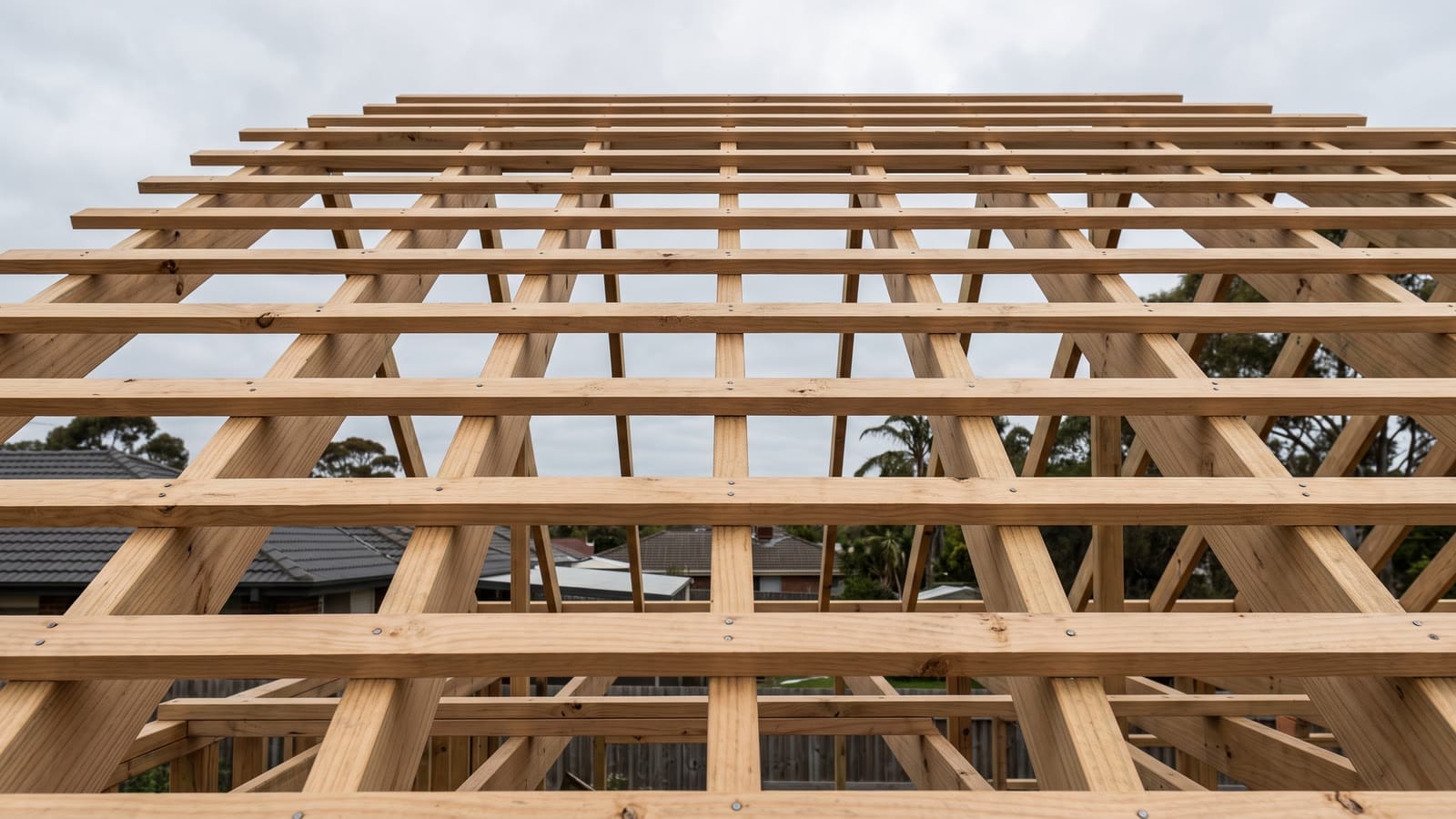
Roof battens spacing is one of the few numbers on a roof you cannot pick. It is not a preference, it is not a rule of thumb, and it is not set by the batten. It is set by the tile going on top of it, and getting it wrong by a few millimetres a course compounds all the way up the roof.
What actually sets roof batten spacing?
The spacing between battens, the gauge, comes out of two numbers belonging to the tile: how long the tile is, and how far it has to overlap the tile below it. That overlap is the headlap, and it is what keeps water out at the joint. Take the headlap off the tile length and what is left is how far apart the battens can sit.
That is why the gauge changes when the tile changes. Profiles are laid at different densities and different minimum pitches, and those differences are real. Monier’s Elabana lays at 9.6 tiles per square metre at a minimum pitch of 17 degrees, Atura at 10.2 and Madison at 10.5 at the same pitch, and Horizon at 10.8 with the minimum pitch dropping to 15 degrees. Four profiles from one manufacturer, four different sets of numbers.
Getting the tile right first is the whole job. Slight differences in cover width or interlock shape cause tile lift, leaks and failed inspections, so if you are matching an existing roof rather than starting fresh, work out what you have before you order anything. The photo and tape measure method is in identify your tile profile.
Working the gauge out from your tile
Take a Bristile Marseille as the worked example, because it is one of the few profiles with published dimensions. It measures 466 millimetres long and 260 wide, weighs about 3.6 kilograms, and carries a headlap range of 75 to 110 millimetres.
Run the arithmetic and the gauge falls between roughly 356 and 391 millimetres, depending on where in that headlap range you sit. Tighter headlap, wider batten spacing and fewer battens. More headlap, tighter spacing and more of them. Where you land inside the range is driven by pitch and exposure: a lower pitch or a more exposed elevation wants more overlap, not less.
Treat that as the method rather than as a specification. Confirm the figure against the manufacturer’s headlap chart for your exact profile before anyone starts fixing battens, because the ranges vary between profiles and sometimes between batches, and we supply the materials rather than fit them. Bristile publishes headlap charts and batten spacing guides for its range, and we can check compatibility with you before an order goes out.
What size battens does a tiled roof need?
Two sizes cover standard tiled roof work in Sydney, and we stock both. Which one you need depends on rafter spacing and the load above, and that load is not trivial: a concrete tiled roof weighs between 42 and 48 kilograms per square metre, which means the structure has to carry roughly 50 kilograms per square metre once the battens and sarking are counted in with the tiles.
The heavier section is 38 by 38 pine battens, square in profile.
The lighter is 28 by 38 pine battens, in the same pine and sold in the same bundle sizes.
How many battens will the job take?
Once you have the gauge, the quantity follows from the roof area and you can order in whole bundles.
Battens are sold in bundles of eight 3.6 metre lengths, which is 28.8 lineal metres a bundle. Half bundles come as eight 1.8 metre lengths for 14.4 lineal metres, which is the more sensible order on a small repair or a single roof plane. Bulk buy pricing is available on both sizes, so it is worth asking before you order a large job rather than after.
The full range, including sarking, tape and fixings, sits in roof battens and sarking.
Call (02) 9756 3350 with your profile and roof area and we will work the quantity through with you, or ask about battens through the contact form. We are at Prospect, Monday to Friday 6.30am to 4.00pm and Saturday 7am to 11am.